Fungi Source begins as a hunt. We comb the Biodiversity Heritage Library, the Internet Archive and Project Gutenberg — and antiquarian catalogues beyond them — for anything written about, or useful to the study of, fungi. Every lead is read, sourced, and its rights status established before it earns a place.
Much of the canon is locked in Latin, French, German, Italian and Swedish. Part of the work is OCR and translation — turning page scans into searchable, readable text — then structuring it into a single open database. Free and open-sourced and shared through an API, the collection becomes raw material to power AI tools, research and visualisation. A caveat travels with the old volumes: treat their edibility guidance as history, not a foraging manual.
The collection
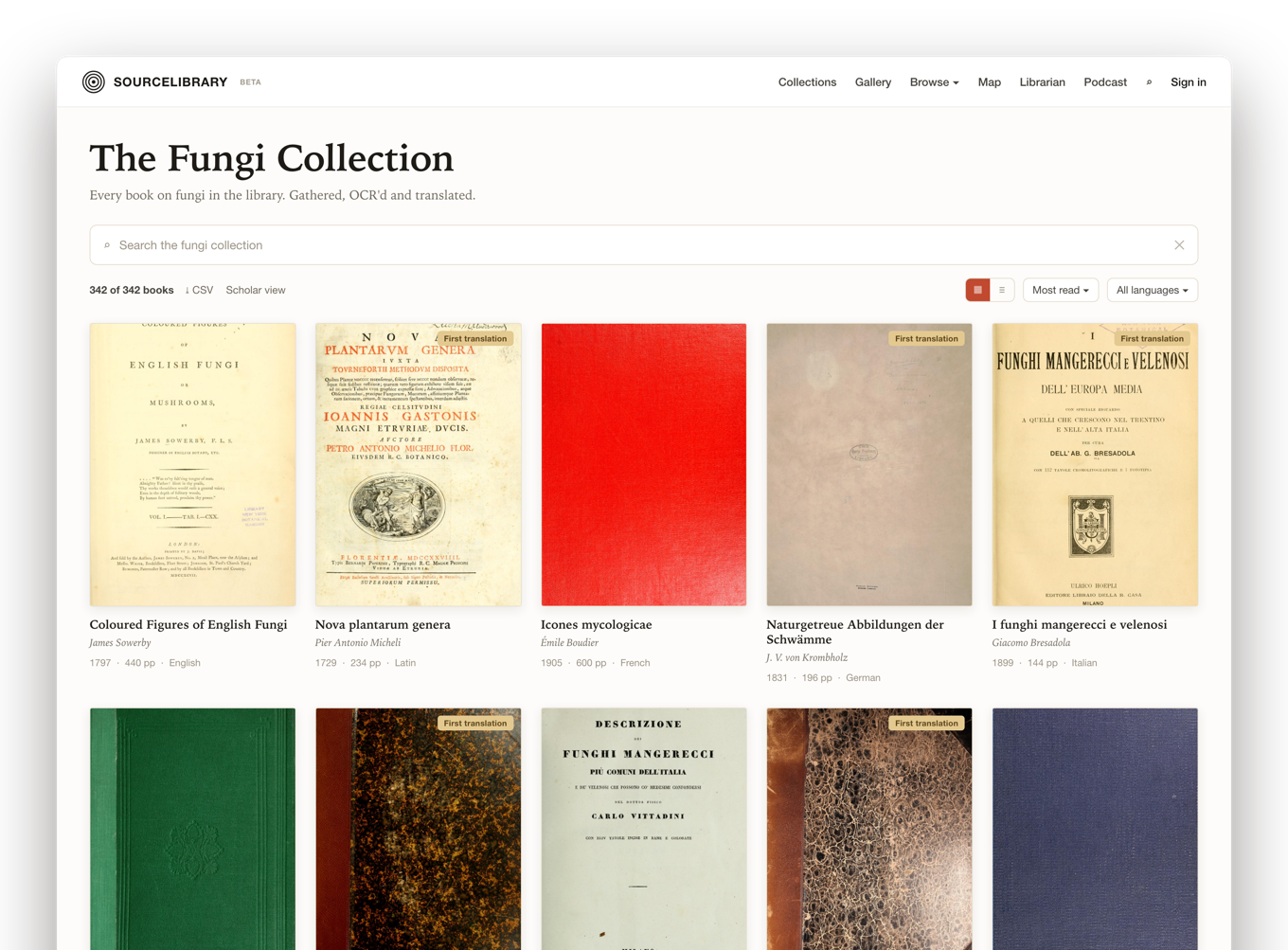
60 titles across 7 languages and three centuries — every one public domain, with the full book a click away on the Internet Archive. A working seed of the database; it grows continuously. Tap a cover for the summary, details and the download.
Plates
A wall of the finest public-domain illustrations in the collection — hand-coloured engravings and lithographs from Schäffer, Sowerby, Hussey, Krombholz, Bulliard, Boudier, Cooke and more. Tap any plate to enlarge.
One open database, handed to Source Library
Each title is OCR'd, translated where it's needed, and catalogued — author, year, language, subject, provenance, rights and a link to the scan — into one centralised, open dataset. Published free and open-sourced and shared through an API, so anyone can build on it: AI tools, research, cross-text insight and visualisation. The collection is ported into sourcelibrary.org, where it's published, browsed and grown — this page is the record of the effort behind it.
View the Source Library project →More projects
Algorithms V1
Open →
Instruments
Open →
SMA Config
Open →
Algorithms V2
Open →
Symcyto
Open →
Timelapse Media
Open →
Cymatics Simulator
Open →
Cymatics in Bubbles
Open →